The 2026 World Cup does not only fill stadiums — it fills training grounds. Every tournament of this scale spikes the motivation of thousands of young players who train more hours, copy their idols and compete harder. The problem is that this enthusiasm lands on bodies that are still growing — and a growing body does not get injured, nor recovers, the way an adult’s body does. Youth football injuries follow their own rules, and treating them like adult injuries is a mistake.
For the physiotherapist, sports doctor or strength & conditioning coach working in an academy, this raises a challenge that is rarely addressed with the rigour it deserves: how do you treat and rehabilitate a footballer whose skeleton has not yet finished forming? This article explains why youth football plays by its own physiological rules, which youth football injuries dominate it, and how 2nd-generation Tecar therapy can be adapted to the growing athlete — with clinical caution and respect for the growth plate.
The World Cup Effect on Academy Football
The impact of a World Cup on grassroots and academy football is real and measurable. Enrolment in schools and academies rises in the months following every major tournament, and registered players spontaneously increase their training volume. More playing hours, more sprints, jumps and kicking repetitions, and more summer friendlies translate, from a clinical standpoint, into one thing: a sharp rise in load on structures that are not yet mature.
And here is the nuance that separates a strong academy medical team from the rest: that load spike is not dangerous in itself, but it can be depending on how and when it arrives. A rapid increase in volume, right at the growth-spurt phase, on top of an already congested calendar, is the exact recipe for the overuse injuries that empty academy benches every season.
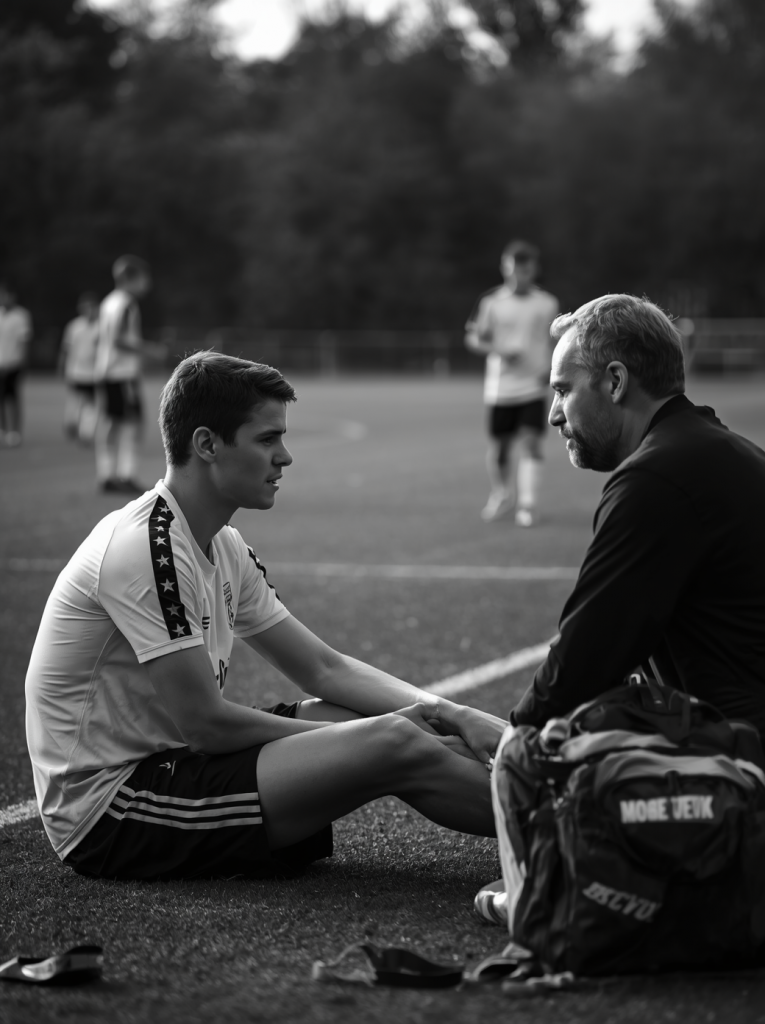
Why a Youth Player Is Not a Small Adult
The fundamental difference lies in where the weakest link of the chain sits. In an adult, under intense traction, the muscle or tendon usually fails first. In a growing adolescent, the weakest link is different: it is the apophysis — the cartilage zone where the tendon anchors to a bone that is still growing. That cartilage is weaker than the tendon pulling on it, so the injury occurs in the developing bone, not in the muscle.
During so-called peak height velocity (PHV) — the moment of fastest growth — the long bones lengthen faster than the surrounding muscles and tendons. The result is a temporary loss of flexibility, increased stiffness and sustained traction on the apophyses. The academy-football literature is consistent on this point: the period during and up to 12 months after peak height velocity is the young athlete’s highest injury-risk window.
The Youth Football Injuries That Dominate Academy Play
The most frequent youth football injuries are not the same as in the professional game. Here, overuse injuries and apophysitis (inflammation of the apophyses from repeated traction) lead the way. This is the reference table for the medical and coaching team:
| Condition | Typical age | Anatomical site | Mechanism | Recovery approach |
|---|---|---|---|---|
| Osgood-Schlatter disease | 12–15 yrs | Tibial tuberosity (knee) | Repeated patellar-tendon traction during the growth spurt | Load control + gentle capacitive mode + quadriceps flexibility |
| Sever’s disease | 8–12 yrs | Calcaneal apophysis (heel) | Achilles traction on the growing heel | Offloading + low-intensity peripheral capacitive |
| Sinding-Larsen-Johansson | 10–14 yrs | Inferior pole of the patella | Repeated jumping and kicking | Jump control + capacitive + progressive eccentrics |
| Adductor overload | 13–16 yrs | Pubis / adductors | Direction changes, strength imbalance | Capacitive muscular + strength reconditioning |
| Muscle injury (grade I) | 15–18 yrs | Hamstrings / calf | Maximal sprint in an already mature player | Adapted TECAR protocol (see Blog 2) |
The Mistake of Treating a Youth Player Like a Pro
The most common mistake when managing youth football injuries is to apply the same aggressive protocol that works in adults.
The three keys to adaptation are:
- Capacitive and drainage priority. The capacitive mode, at low-to-medium intensity, works on muscle, circulation and the lymphatic system without concentrating deep energy on the growth-plate cartilage. It is the mode of choice in youth football.
- Avoid aggressive deep resistive over an active apophysis. The resistive mode drives energy into deep tissue — tendon, bone, periosteum. Over an open, inflamed apophysis it must be used with extreme caution or avoided until symptoms resolve.
- No intense deep heating. The goal is not to ‘heat hard’ but to support recovery. Moderate intensities, shorter sessions and a focus on the young athlete’s comfort.
Put simply: in academy football, Tecar therapy is a tool for recovery and support, not aggressive treatment. And it should always sit inside a plan whose cornerstone is training-load management.
A Tecar Protocol Adapted to Academy Football
This is the practical translation for the academy physiotherapist. It does not replace individual clinical judgement or load control, but it offers a safe starting framework:
| Situation | TECAR mode | Intensity | Duration | Objective |
|---|---|---|---|---|
| Active apophysitis (Osgood / Sever) | Peripheral capacitive | Low | 15–20 min | Drainage and relief without loading cartilage |
| Post-training recovery | Capacitive muscular + drainage | Low-medium | 15–20 min | Reduce accumulated lower-limb fatigue |
| Muscle overload, no injury | Capacitive muscular | Medium | 20 min | Prepare tissue and prevent injury |
| Post-PHV player (already mature) | Capacitive + cautious resistive | Medium | 20–25 min | Approach the young-adult protocol |
What a Club Gains by Looking After Its Academy
Beyond the youngster’s health — which comes first — looking after the academy delivers a concrete return for the club:
- Less dropout through injury. Poorly managed growth injuries are a frequent reason talented youngsters stop playing. Managing them well retains talent.
- Players who reach the first team healthy. An academy invests years and resources in developing a player: Protecting them through the highest-risk phase protects that investment.Understanding how to treat sports injuries effectively is key to protecting that investment.
- A reputation for duty of care. Families choose academies that look after their children. Offering professional-level recovery adapted to the youth athlete is a genuine differentiator against rival clubs.
For the club or academy ready to make that step up in quality, having a 2nd-generation Tecar device — able to modulate intensity and mode with precision — means offering young players safe recovery tailored to their growth phase. It is not the first-team’s technology transplanted as-is: it is the same technology, applied with a sports-paediatric mindset.
Frequently Asked Questions (FAQ)
Can Tecar therapy help with youth football injuries in adolescent players?
Yes, with adaptations. In growing athletes, the low-to-medium-intensity capacitive mode and drainage are prioritised, avoiding concentrating deep energy over open apophyses. It must always be applied by a healthcare professional, within a plan that includes training-load control.
At what age do growth-related football injuries appear?
It depends on the condition. Sever’s disease typically appears between ages 8 and 12; Osgood-Schlatter between 12 and 15. The highest-risk period coincides with peak height velocity and the 12 months that follow.
Why isn’t a youth player treated the same as a professional?
Because the weak link differs. In adults, muscle and tendon fail; in adolescents, the apophysis (the growth-plate cartilage where the tendon anchors). An aggressive protocol designed for mature tissue can be counterproductive on a developing structure.
Does Tecar therapy cure Osgood-Schlatter disease?
Tecar therapy does not ‘cure’ on its own: Osgood-Schlatter usually resolves with skeletal maturation and proper load management. Tecar therapy can support recovery by easing symptoms and improving comfort, always as part of an integrated approach.
