Hamstring injuries football: clinical criteria for return to play
Hamstring injuries football management is one of the most clinically demanding challenges in professional sports medicine. Their high recurrence rate, the impact of days lost from competition, and the pressure to accelerate the return to play have placed hamstring management at the core of the contemporary debate in sports medicine.
In the coming weeks, this will be one of the central topics of the XXX AEMEF Course (the Spanish Association of Football Team Physicians), to be held in Oviedo from 28 to 30 May 2026. Capenergy, a European manufacturer of professional TECAR therapy equipment, participates as official sponsor of the course and shares in this article a technical review of the role of deep capacitive-resistive radiofrequency in the rehabilitation of hamstring injuries in professional footballers.
1. Hamstring injuries: the most prevalent injury in professional football
Data from the UEFA Elite Club Injury Study, ongoing since the 2001/2002 season, has consistently established that hamstring injuries account for between 12 % and 17 % of all injuries recorded in elite European squads. In other words, almost one in every six injuries in a professional football squad affects the hamstring muscle group.
Beyond their volume, the sporting and economic impact is significant. A moderate-grade tear of the biceps femoris can keep a player out of competition for 14 to 28 days, and high-grade tears may exceed 60 days of effective absence. At squad level, this translates into a direct loss of available minutes, the need to rehabilitate the player and, frequently, a recurrence in the following months.
Classification, imaging and the recurrence challenge
The two most widely used classifications in professional football are the Munich Consensus Statement (Mueller-Wohlfahrt et al., 2013) and the British Athletics Muscle Injury Classification (Pollock et al., 2014). Muscle ultrasound remains the most accessible field tool for diagnosis and follow-up; magnetic resonance imaging is the gold standard in grade 3 and 4 injuries.
Recurrence rates of 12 % to 31 % within six months after return to play remain a major challenge. The most frequent causes of failure include premature return to play, unstructured rehabilitation protocols, lack of progressive eccentric strengthening, and incomplete tissue regeneration. These factors justify the integration of therapeutic tools that act specifically on the quality of tissue regeneration and on the preparation of the muscle to withstand high-velocity demand again.
2. Classification, imaging and the recurrence challenge
The two most widely used classifications in professional football are the Munich Consensus Statement (Mueller-Wohlfahrt et al., 2013) and the British Athletics Muscle Injury Classification (Pollock et al., 2014). Muscle ultrasound remains the most accessible field tool for diagnosis and follow-up; magnetic resonance imaging is the gold standard in grade 3 and 4 injuries.
Recurrence rates of 12 % to 31 % within six months after return to play remain a major challenge. The most frequent causes of failure include premature return to play, unstructured rehabilitation protocols, lack of progressive eccentric strengthening, and incomplete tissue regeneration. These factors justify the integration of therapeutic tools that act specifically on the quality of tissue regeneration and on the preparation of the muscle to withstand high-velocity demand again.
3. Mechanism of deep capacitive-resistive radiofrequency in muscle tissue
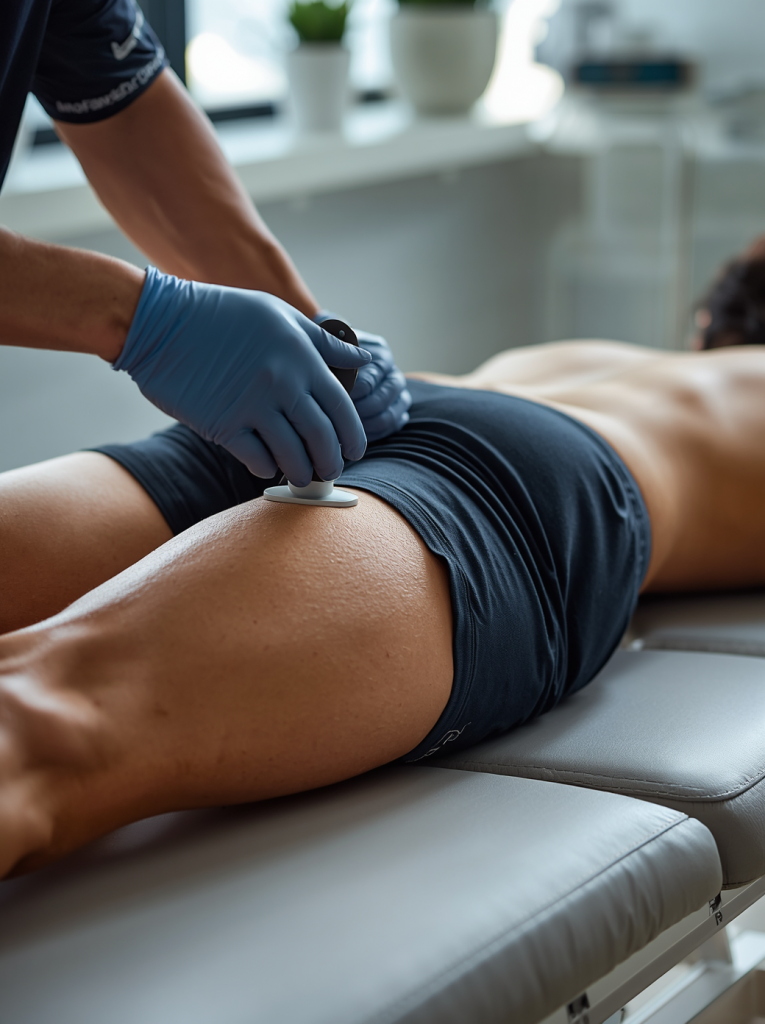
TECAR therapy is a form of deep electrotherapy based on capacitive and resistive radiofrequency currents (CR-MRF). Its therapeutic effect operates simultaneously at several levels: bioelectrical modulation of the cell membrane and the Na+/K+ ATPase pump (Hazlewood and Markov, 2007), thermal effect with vasodilation and improved local blood flow, and stimulation of new collagen organisation and degradation of fibrotic tissue (Milesallen and Baley, 1999). The combination of capacitive (CAP) and resistive (RES) modes allows the clinician to target both the muscle belly and the myotendinous junction in the same session.
4. Clinical evidence in muscle injuries
The clinical evidence supporting TECAR therapy in muscle and musculoskeletal injuries has grown significantly over the last decade. Sodré et al. (2018, Physical Therapy in Sport) reported a 5 % increase in muscle capacity following capacitive-resistive radiofrequency intervention in athletes. Tramuntana et al. (2020) reported up to 90 % clinical resolution of low back pain in 10 days, with up to 300 % greater effectiveness in the group treated with Capenergy technology combined with drainage compared to conventional TECAR. Tramuntana (2019, Medicina dello Sport) documented tissue matrix reorganisation in calcific tendinopathy under ultrasound follow-up.
5. Clinical protocol: integrating TECAR into hamstring rehabilitation
| Phase | Timing | TECAR mode | Therapeutic goal |
|---|---|---|---|
| Acute phase | 0–72 h | Athermal low-intensity (CAP) |
Analgesia, inflammation control, haematoma drainage. |
| Subacute phase | 3–14 days | Athermal / low thermal (CAP + RES) |
Cellular stimulation, vascularisation, early analgesic mobility. |
| Rehabilitation | 2–4 weeks | Controlled thermal (CAP + RES) |
Collagen reorganisation, progressive eccentric work, functional load. |
| Return to running / sport | 4–8+ weeks | Maintenance thermal (RES) |
Pre-effort tissue preparation, recurrence prevention, performance optimisation. |
6. Capenergy TecarEvolution technology in professional football
The Capenergy TecarEvolution range (C200, C300, C400) has been engineered for the demands of high-performance sports medicine. Common technological differentiators include the SYSTEMAP multi-frequency system (0.8 / 1 / 1.2 MHz), Crossfires (simultaneous CAP + RES application, exclusive to Capenergy), 310 W of real useful power per channel (possibility of having up to 4 channels in one device), automatic temperature sensor, 200 cm² treatment surface per automatic plate and a documented 94 % increase in basal metabolism in the treated area. Model selection (2, 3 or 4 channels) depends on the type of medical service and desired treatment volume: clinical practice, professional club medical staff, federation services or high-performance rehabilitation centres.
7. Capenergy at the XXX AEMEF Course (Oviedo, 28-30 May 2026)
The XXX AEMEF Course reaches its thirtieth edition in 2026 and, for the first time, takes place in the Principality of Asturias. The venue is the Palacio de Exposiciones y Congresos de Oviedo. The scientific programme includes six debate panels covering Return to play, Women’s football, Stadium medical organisation, Physiology and nutrition, Hamstring injuries (¿qué podemos hacer?), and a hands-on muscle ultrasound workshop on Thursday 28 May led by Dr. Ramón Balius and Dr. Xavier Valle. Featured speakers include Dr. Lasse Lempainen (Finland), Dr. Claudio Vázquez (Head of the Spanish Football Federation Medical Services), Dr. Miguel del Valle, Dr. Jorge Guadilla, Dr. Nicolás Terrados and Dr. Marta S. Martinho Pinto, among more than twenty national and international speakers.
Capenergy participates as official sponsor of the XXX AEMEF Course and will host its own stand throughout the three days in the sponsors’ area of the Palacio de Exposiciones y Congresos de Oviedo. The Capenergy team will be available to football team physicians and other attending professionals for clinical protocol review, live demonstration of TecarEvolution equipment and technical consultation on integration of TECAR therapy into football medical services.
